EB 1A CRITERION: AUTHORSHIP OF SCHOLARLY ARTICLES IN THE FIELD, IN PROFESSIONAL OR MAJOR TRADE PUBLICATIONS.
The Scholarly Articles criterion requires the applicant to demonstrate that they have authored academic works that have made significant contributions to their field. USCIS will evaluate the quality, credibility, and impact of these publications to determine if they meet the extraordinary ability threshold.
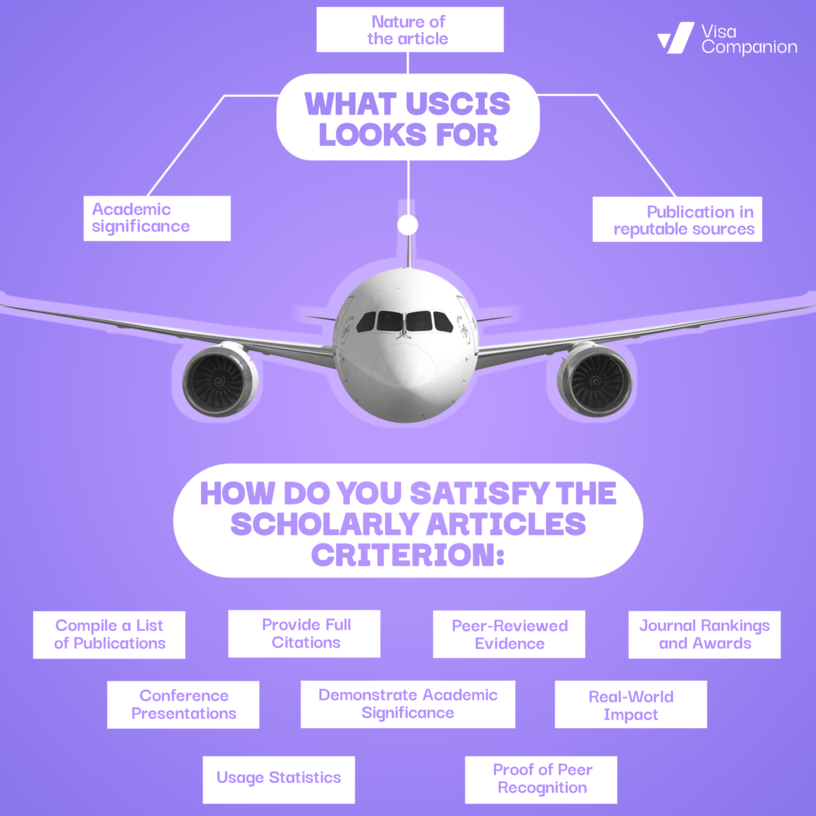
What USCIS Looks For
- Nature of the Article: The scholarly article should report on original research, experimentation, or discourse and be intended for an audience of professionals, academics, or learned individuals in the field. It is typically peer-reviewed and contains references such as footnotes, endnotes, or a bibliography.
- Publication in Reputable Sources: The article should be published in a reputable, peer-reviewed journal, or presented at a nationally or internationally recognized conference. USCIS looks for articles that have been vetted by experts and deemed valuable contributions to the field.
- Academic Significance: The article should have a meaningful impact on the field. This could be demonstrated through citations, implementation by other researchers, or real-world applications that arose from the research.
HOW DO YOU SATISFY THE SCHOLARLY ARTICLES CRITERION
- Compile a List of Publications:
Start by identifying all scholarly articles you have authored. This may include:
Research papers published in peer-reviewed academic journals.
Conference proceedings where you presented original research.
Book chapters or monographs related to your field of expertise.
This example would suffice: A biochemist who has published articles on new methods of protein analysis in the “Journal of Biochemistry” or presented findings at the American Chemical Society Conference.
- Provide Full Citations:
When submitting evidence, include the full citation for each scholarly article. This should cover:
- Title of the article.
- Name of the journal or conference.
- Date of publication or presentation.
- Page numbers and author attribution.
- Peer-Reviewed Evidence:
Provide documentation that demonstrates the article was peer-reviewed. This could be submission records from the journal, communication with the editor, or a note on the article itself stating that it underwent peer review. This is crucial for establishing the credibility of the publication.
- Demonstrate Academic Significance:
Explain how the article has advanced the field. To prove this, you can provide:
Citation Metrics: Use databases like Google Scholar or Researchgate to gather citation counts for your work.
Usage Statistics: Download metrics from platforms like ResearchGate or academia.edu to show how widely your work is being accessed and utilized.
Real-World Impact: Provide examples of how your research has influenced others in the field, been implemented in industry, or led to policy changes.
- Journal Rankings and Awards:
If your articles are published in high-ranking journals or have received awards, include this information as it will significantly boost your profile. Provide evidence of the journal’s ranking, such as its impact factor or position in academic ranking lists like the ISI Journal Citation Reports.
- Conference Presentations:
If your scholarly articles were presented at recognized national or international conferences, include evidence of your participation, such as presentation schedules, conference brochures, or certificates of participation.
- Proof of Peer Recognition:
Demonstrate how your scholarly work has garnered peer recognition, such as being listed as required reading in academic courses, cited in textbooks, or referenced in major studies or white papers.
Meeting the EB-1A Scholarly Articles criteria requires a strategic approach. By carefully selecting and presenting evidence that highlights your achievements, media presence, and academic contributions, you can effectively demonstrate your extraordinary ability in your field. Use the steps outlined in this guide to build a strong case for your EB-1A petition.
For further information, you can reach us at admin@visacompanion.ai.